Inside Ciel: Building a Design Intelligence Studio.
Why Ciel Asylum is being built around the intersection of design, digital experience, artificial intelligence, technology, and the systems that hold them together.
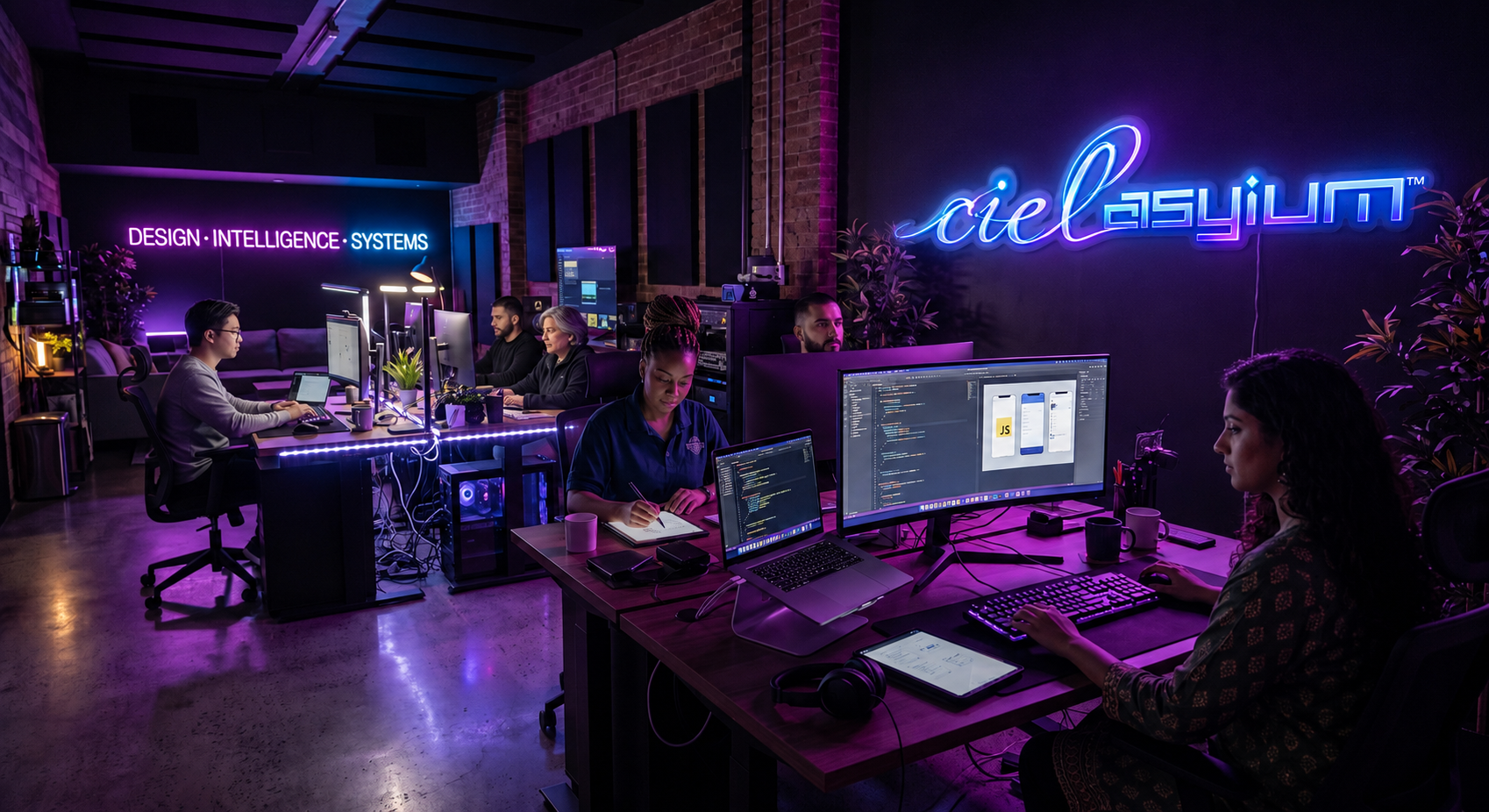
Ciel Asylum is not being built as a traditional creative agency with a technology layer added afterward. The studio is being shaped around a broader idea: design is most valuable when it can understand the system around the experience, not just the surface of it.
That means looking at brand, interface, content, automation, infrastructure, and customer behavior as parts of the same operating environment. The visual layer still matters deeply, but it becomes stronger when it is connected to how the business actually works.
Design intelligence begins where disciplines stop being isolated.
For years, organizations have separated creative, marketing, technology, operations, and strategy into distinct lanes. That structure can make sense internally, but customers do not experience a business in departments.
They experience the brand, the website, the form, the email, the response time, the payment flow, the support experience, and the technology underneath all of it as one continuous relationship.
When those layers are designed separately, the seams become visible. A beautiful website can lead into a confusing process. A strong brand can sit on top of weak digital infrastructure. An AI feature can create more friction than it removes. A technically capable system can still feel difficult to use.
“Design intelligence is not about making every part of the business look designed. It is about making the parts work together with intention.”Ciel Asylum Editorial
Four ideas shape the studio Ciel is becoming.
Design is a decision system.
Visual identity, layout, hierarchy, interaction, language, and motion all encode choices about what matters. Good design helps an organization make those choices consistently rather than treating every touchpoint as a new problem.
Technology should support the experience.
Infrastructure, integrations, analytics, forms, automation, and platform decisions are not separate from customer experience. They determine whether the experience continues to work after the visual layer ends.
AI should create leverage, not spectacle.
Artificial intelligence is most useful when it reduces repetitive work, improves access to information, expands creative exploration, or helps the system respond more intelligently without becoming another thing people have to manage.
Clarity is an operating principle.
The strongest systems make complexity easier to navigate. That applies to the interface, the offer, the workflow, the technology stack, and the way the business communicates what happens next.
The studio model is intentionally hybrid. The goal is not to blur disciplines for the sake of novelty. It is to connect the disciplines customers already experience as one system.
Why call it design intelligence?
Because the work increasingly requires more than visual execution. A strong digital experience may require brand judgment, systems thinking, technical awareness, automation logic, content strategy, and an understanding of how people move through decisions.
Design intelligence is the layer that connects those inputs. It asks not only whether something is attractive or technically functional, but whether the whole experience is coherent, useful, maintainable, and aligned with the business.
That perspective changes the role of the studio. The work is not limited to producing assets. It can include shaping the system that determines how those assets, interfaces, and technologies behave together.
The studio itself has to operate the way it advises clients to operate.
That means Ciel cannot treat process as something hidden behind the creative output. The internal workflow has to become more intentional too. Reusable systems, stronger documentation, clearer standards, selective automation, and better connections between creative and technical work all matter.
The same principle applies to AI. It should accelerate research, production, ideation, analysis, and repetitive tasks where it creates real leverage, while human direction remains responsible for strategy, taste, judgment, and the final experience.
Building the studio this way is part of the work itself. The operating model becomes another design system.
Small and mid-sized organizations often need this integration the most.
Larger organizations may have dedicated teams for brand, design, IT, analytics, automation, security, content, and operations. Smaller businesses rarely do, even though they increasingly depend on many of the same digital capabilities.
That creates a practical opportunity for a studio that can move across those boundaries without forcing the client to coordinate five separate conversations.
The goal is not to recreate an enterprise department structure for a smaller company. It is to identify the essential layers, connect them intelligently, and scale the solution to the reality of the organization.
Ciel Asylum is still being built, and that is part of the point.
A design intelligence studio should not pretend the environment around design and technology is finished. AI is changing creative workflows. Customer expectations are changing digital experiences. Websites are becoming operational platforms. Small businesses are becoming more dependent on cloud infrastructure and automation.
The studio has to evolve with that environment while keeping a stable point of view about what should not change: clarity, intentionality, human judgment, useful technology, and experiences that respect the people using them.
That is the direction of Ciel Asylum. Not a creative agency that happens to use technology, and not a technology consultancy that happens to care about design. A studio built to understand the relationship between both, and to turn that understanding into systems people can actually use.
From the Journal.
See what your own system is signaling.
Use the Ciel Signal assessment for a diagnostic view of your brand, digital experience, intelligence, and technology foundation, or start a project when you are ready to build what comes next.